Posts

Keeping Grief Away

Image
I read a lot of fiction. SF, thrillers, detective fiction, literary fiction, all kinds of stuff. In none of it do I find rape, murder, genocide and war occurring so regularly as in the Carnegie Medal winners I've been reading in the last few months. This month I've read  Buffalo Soldier  by Tanya Landman, 2015 winner (rape, lynching, murder, genocide, ethnic cleansing, American Civil War, Indian Wars) and  Salt to the Sea  by Ruta Sepetys, 2017 winner (rape, murder, ethnic cleansing, maritime disaster with thousands of deaths, WW2). Did I enjoy them? Not really. Is enjoyment even an appropriate response to these novels? Well, probably not. Are they children's books? No. So why, then, are they not adult books? (Not that that is even a category). The subject matter is at least as extreme as most adult fiction that I read. I'm beginning to suspect that an important distinguishing feature of YA fiction is that it lacks  complexity.  I know that's a ridiculous o...
The Sense of an Ending

Image
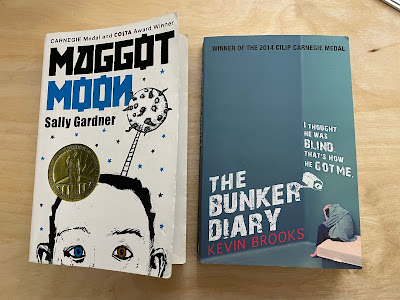
Yes, I am getting close to the end. This month I read   Maggot Moon   by Sally Gardner, the 2013 Carnegie Winner, and   The Bunker Diary   by Kevin Brooks from 2014. Neither book did much to cheer me up, even though both are about the human spirit in the face of adversity. Both books (spoiler alert) end in death, and in the case of   The Bunker Diary   (even more spoiler alert)   everyone   dies. I found things to admire in both books. In  Maggot Moon  Standish Treadwell is a wonderful creation and his relationship with his friend Hector is touching and beautifully drawn. But the future dystopian world where Standish lives—or is it a 1950s world where the Nazis won the war?—that world seems to me very like the unconvincing stage-set the authorities of Motherland have built to fake a moon landing. There's not much to it—a street, a school, a housing estate and a weird building. It's like a TV series that's been shot on a very tight budget...

Monsters and More Monsters

Image
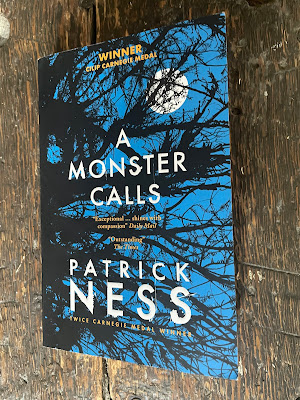
I've always been happy to abandon a book after 50 pages (or less) if I'm not enjoying it.  Occasionally the first page is enough. Then, in March 2020, just before the first lockdown, I decided to read all the Carnegie winners in order, and write about the experience here. I don't think I realised how long it was going to take (maths was never my strongest subject) and here I am, starting on my fifth year of reading.  There have been 84 winners of the Carnegie Medal so far and it was too much to hope that I would like all of them. When I haven't enjoyed a book I've found myself quite reluctant to write about it, but I'm interested in describing the  experience  of reading all these books as well as in saying a bit about the books themselves, and that means that occasionally I need to find ways of saying what I didn't like, or felt didn't work. And that, of course, is as much about me as about the book.   Patrick Ness won the Carnegie twice in 2011 and 201...

Death and the Carnegie Medal

Image
  Death has always been a presence in Carnegie Medal winning books. The third winner, Noel Streatfeild's  The Circus is Coming  begins like this: "Peter and Sarah were orphans. When they were babies their father and mother were killed in a railway accident, so they came to live with their aunt." This is an extreme example of how children's authors get rid of the parents to allow the children some agency. Roald Dahl did a very similar thing in  James and the Giant Peach  although he waited until the second paragraph to dispatch James's parents by means of an angry rhinoceros. Both Streatfeild and Dahl are just clearing the ground before they start their stories, cutting the protagonists free from those pesky parents. Books like  The Lantern Bearers  and  Tulku  do the same thing in a more organic way, but although people die in both these books, death is not central to the stories. There are other winners with high body-counts, like Ronald Wel...

Believability

Image
All fiction is a kind of conspiracy between author and reader. The author pretends that what they are writing is true and the reader pretends to believe them. I know there's a lot more to it than that—the author probably has something they want to say through shaping the events and characters in their story and the reader may be searching for some kind of truth, or a new way of looking at things, and what is truth anyway? But for the whole thing to work the reader has to be able to convince themselves while they are reading that what they are reading is true.  So when I started reading Meg Rosoff's Carnegie Winner  Just in Case  and discovered that the central character is named Justin Case, that contract between the writer and this particular reader was immediately undermined. I mean, Justin's parents seem quite ineffectual, but I couldn't believe that  any  parents would deliberately do that to their child. Justin lives in a weird world. It's a world where tod...

One Eye on the Grown-up

Image
What interested me most, when I started reading the Carnegie Medal winning books from the beginning, was the prospect of discovering books and authors I'd never heard of, or who I'd heard of but had never read. I spent a lot of time, early on, exploring the backgrounds and connections of some of those authors, and I'm glad I did, especially in the case of Walter de la Mare whose novels,  Memoirs of a Midget  and  The Three Royal Monkeys  are truly extraordinary books which I doubt are much read today. Reading those early winners was a kind of literary archaeology, but now that I've entered the new millennium I'm not having quite as much fun, and I'm wondering why? I am a confirmed re-reader of books I love. I don't know if this is a bad thing or not, but after reading a dozen or so new books I usually find myself going to the bookshelves and taking down a John le Carré, for example, or a thriller that I remember enjoying but read long enough ago to have forg...

Lost for Words

Image
  I've read more than 60 Carnegie Medal winning books now, and I've found none of them more difficult to write about than Beverley Naidoo's  The Other Side of Truth . It belongs to a loose category of winners that appear to originate in an author's desire to educate their readers. Social realism I suppose. I'd include Berlie Doherty's books here, and probably Melvin Burgess's Junk. It's not surprising that adults writing for children should be interested in the effect their writing has on those readers. Here's Beverley Naidoo on why she writes: "I am frequently asked, 'Have you a message in what you write?' My reply is that writing fiction is quite different from declaiming from a soapbox or through a microphone. I do not write to deliver a 'message'. Yet I believe passionately in the importance of literature that engages with life and our moral human universe." The Other Side of Truth  shines a light on the abuses of the mi...