Posts

Vaster than Empires and More Slow

Image
  It was, of course, Andrew Marvell, not me, who wrote 'vaster than empires and more slow', but the line kept coming into my mind as I was thinking about the two books in this month's post. Some time or other, probably at school, I was told that the Romans came to Britain, stayed a few hundred years, and then left when the Empire started to crumble and they had to get back to defend Rome against marauding barbarians. After that, life in Britain more or less reverted to the uncivilised state that had existed before the Romans arrived, and everything went dark until the Normans came. Rosemary Sutcliff likes to shine a light on those supposed 'dark ages', though in her use of the image of 'lantern bearers' carrying the light of Roman (and Christian) civilisation forward after the Romans left, she is, in a way, perpetuating the idea of an age of darkness. But that doesn't prevent this being a brilliant book. Sutcliff describes how, while making toast for bre...

Of Gardens and Time Travel

Image
I recently re-read Philippa Pearce's Tom's Midnight Garden , the winner of the 1958 Carnegie Medal. It was a surprising experience in many ways, because this was not quite the book I thought I remembered. When I'd finished it, I was inspired to return to the greatest of all children's books about gardens, The Secret Garden by Frances Hodgson Burnett, first published in 1911. Just think - Tom's Midnight Garden was published 63 years ago, and The Secret Garden a mere 47 years before that. Time does indeed seem to play strange tricks as we grow older. Philippa Pearce writes a great deal about Time, but that's not what gives her book its power to move the reader, for this is a book about loss and longing, about memory and grief, about the way the world changes throughout a long lifetime. I never read this book as a child, and first discovered it when I was in my twenties, at an age when one lives in the present and the future rather than in the past. And though m...

The Strange Case of William Mayne

Image
My reading of Carnegie Medal winning books has brought me to 1957 and to the strange case of William Mayne, whose novel, A Grass Rope , won the prize that year. For reasons that I’ll explore later Mayne was considered one of the most important children’s authors of the second half of the twentieth century. He also became perhaps the most notorious, after his conviction in 2004 for a series of sexual assaults on young girls between the ages of 8 and 16, dating back to the early 1960s. He was sentenced to 2½ years in prison and eventually died in 2010, aged 82.   Julia Eccleshare notes, in her Guardian obituary , that Mayne's books were ‘largely deliberately removed from library shelves following his conviction,’ and a quick check of my local library’s catalogue reveals that only one of his books is currently available to borrow, out of approximately 100 that he wrote. Whether very many of those books would still be on the shelves even had he not been convicted is doubtful. Mayne was...

A Peak in Darien

Image
'The advantage  that children's fiction has over other types of writing is its near irresistible appeal to the reader to identify directly with its characters.' (Colin Burrow in London Review of Books 21/1/21) I was reading Burrow's review of two books, one by Ursula Le Guin and the other a collection of interviews and conversations with her, when this sentence brought me up short. Why had I never thought of this? It explains so much about my approach to reading. When I was a child I always read at night, long after I was supposed to be asleep, and when I did finish a book and close my eyes I would carry on the action in my head, I would be one of the characters, be a part of their adventures, imagine new ones. My involvement was total.  One of Le Guin's later additions to the Earthsea trilogy. Those who identified with Sparrowhawk, the wizard of the earlier books, were in for a shock. As Burrow says 'always in Le Guin there is a  sharp ironical turn against any...

What IS a children's book anyway?

Image
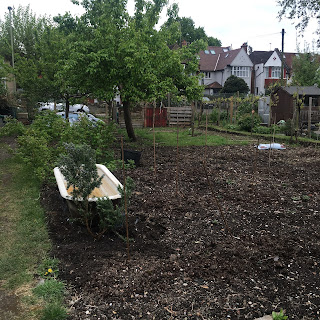
While I've been reading Carnegie Medal winning books I've found this question popping into my head occasionally. Usually I think about it while I'm digging on the allotment and then decide it's not worth writing about. Or rather, I decide that it's too complicated to write about and I'm not really sure what I think. The allotment. Plenty of digging,  plenty of thinking But in the past few weeks I've read a series of historical novels and one non-fiction history book, and that question has kept nagging at me because the books I've read range from one which is definitely written for children to one which, although marketed to children, seems to me to deal with themes which are almost exclusively adult. I suppose the first thing to say is that, speaking (as Noel Streatfeild might have said) as a children's author, all my own books have been written for children, and the subject-matter, style and vocabulary have been carefully adapted to my target audien...

Borrowing

Image
The Borrowers is a remarkable book. Marcus Crouch called it 'flawless', and I agree with him. He also said that 'by its idea alone, one of the few really original ideas in children's literature, it would have been a landmark.' It is a dark and frightening book which is made bearable only by the brilliance of the characterisation and the precise realisation of the Borrowers' lives. It has atmospheric line illustrations by Diana Stanley and wonderful dialogue, but it would be inaccurate to describe it as 'fun' or 'twee'—words I've seen used to describe film adaptations. If you only know the Borrowers through their screen incarnations I recommend you read the book as soon as possible. The Sunday Times review on the back of my copy sums it up brilliantly: 'Beautifully written, poetic and almost always alarming, The Borrowers books have something very mysterious, sad and exciting about them.' The book is a landmark and also, I think, a c...